
The short version
Most trading apps show you a move after it already ran. By the time a name is all over your feed, the entry's gone. Tremor scores the early signal instead, so you can act before the crowd does. I designed and prototyped the whole thing end to end, from the core concept down to a clickable build.
Why I made this
I trade myself, mostly momentum on small caps. The pattern that kept burning me was simple. A name pops up everywhere, I jump in, and I'm buying the top while early money sells into my excitement.'
The signal was always there before the hype. Unusual volume, call buying, chatter ticking up. It's just scattered across five tabs and three apps, and by the time you piece it together the move's over.
So I designed the thing I actually wish existed. One place that watches for the early tells and scores them, so the question stops being "what's moving" and becomes "what's about to."
Who it's for
Active retail traders who chase momentum and keep missing the entry. The Wealthsimple and Discord crowd, watching small caps, living in their watchlist. Not the buy and hold index folks. People who want to be early, not right after everyone else.
The core idea: the Tremor Score
One number, 0 to 100, that blends the early tells into a single read: unusual volume, options flow, social momentum, price action.
I called it Tremor because small tremors come before the quake. That metaphor became the whole product. The score is the thing. Every other screen exists to get you to it fast and help you trust it once you're there.
Designing against the default
Every trading app is a black screen with one neon green accent. It's a default, not a choice, and in a portfolio a default reads as templated. That's death.
So I grounded the entire system in a seismograph, an instrument that reads small movement before the big one. That gave me:
Warm near black instead of cold black, so it feels like an instrument, not a casino
Amber as the single signal color, the readout glow on a seismograph
Muted mint and clay for up and down, quiet enough that the score stays the loudest thing on screen
Space Grotesk for display and a mono for every number, so the data reads like a precise instrument
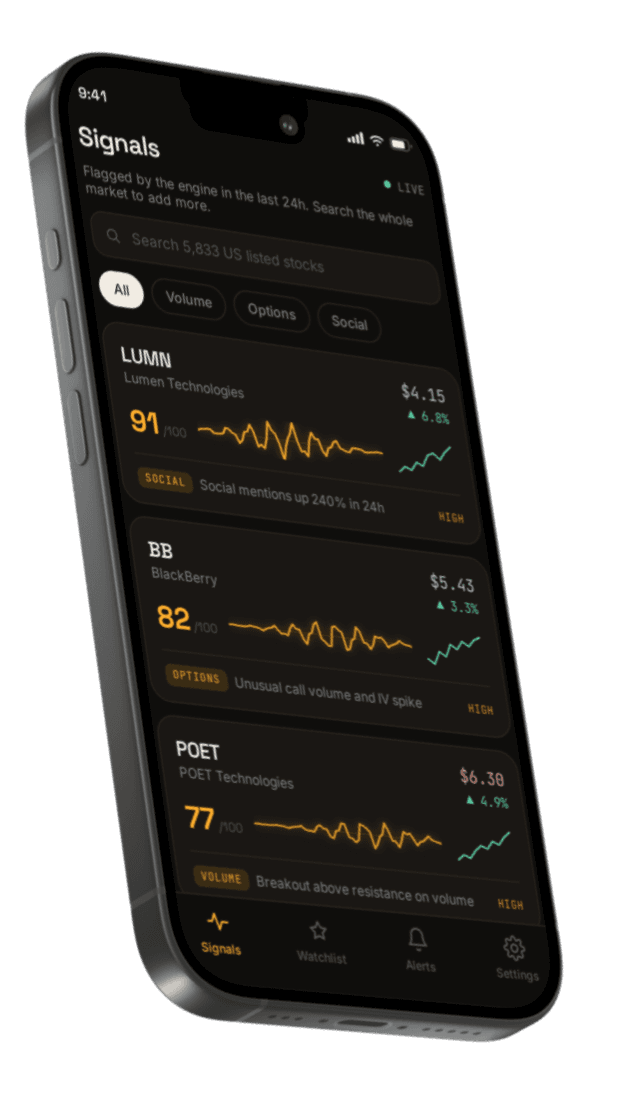
The signature is the amber waveform on every card. The amplitude scales with the score, so a hot name literally shakes harder than a quiet one. You feel the signal before you read it.
I spent all my boldness in that one place and kept everything around it calm. That's the point. One loud thing, not ten.
The flow
Signals. The home feed. Five names showing early movement, each card carrying the score, the live waveform, a sparkline, and one line on why it's flagged with a risk tag. Filters up top by signal type. The only job of this screen is fast triage. You should know in two seconds whether something's worth opening.
The detail view. This is where I spent the most time. Price chart up top, the score rendered as a gauge, and the part I care about most: the why it's flagged breakdown. Four weighted factors, each with a bar, so the score isn't a black box. A score you can't interrogate is a score you won't trust, and trust is the whole game here.
Under that, a risk meter. A high score does not mean low risk, and I refused to hide that. Hiding it would make the app feel like a tip service instead of a tool. Then two actions: add to watchlist, or set an alert.
Watchlist and Alerts. Watchlist is your tracking board for setups you're not ready to act on yet. Alerts is the real payoff. You arm a name and get pinged the second its score breaks out, so you're not chained to the app waiting. Both empty states tell you exactly what to do next instead of just sitting there blank.
What I cut, and why
I killed a news feed, a portfolio profit and loss tracker, and a social following layer. All of them were real ideas. All of them pulled focus from the one job: surface the early signal and help you trust it.
A concept is sharper when it does one thing well. Honestly the scoping was half the design work. Deciding what not to build was harder than building.
What I'd test next
It's a concept, so I'm not going to pretend I have adoption numbers. Here's what I'd actually want to learn:
Does the score breakdown build trust, or do people still want the raw data underneath
Does the risk meter change behavior, or does everyone just ignore it and chase the score
Is the alert the real hook that pulls people back, or is the feed enough
I'd put it in front of five active traders and watch exactly where they hesitate. The hesitation is the design brief.
What I took from it
Starting from a metaphor instead of a screen gave the whole thing a spine. Color, type, the signature, the copy, they all fell out of one idea instead of getting bolted on.
And the most valuable call was the quietest one: what to leave out. The first version of any product is mostly subtraction.