
Cross-border results monitoring for clinicians.
View below
The short version
Protocol was a real cross-border health platform I worked on between Canada and Taiwan. Meridian is the provider side of that idea taken further: a clinician console for monitoring lab results across both countries. The hard part it solves is one most dashboards ignore. The two countries report labs in different units, and a doctor reading across both can misread a value badly. Meridian harmonizes that so the numbers can be trusted at a glance.
Why I made this
Protocol gave me the cross-border health problem up close, the digital and the physical, on both sides of the Pacific. The patient experience got most of the attention. The clinician side, the person actually reading the results and deciding what to do, was where I kept seeing friction nobody was designing for.
So I built the tool for them. Not a patient app, a working console for a doctor who is responsible for people in two countries at once and cannot afford to misread a number.
Who it's for
A clinician managing patients across Canada and Taiwan, watching lab results come in and deciding which ones need action now. They are busy, the stakes are real, and they are switching between two medical systems that do not agree on how to report anything. The design has to earn trust in the first two seconds or it is useless to them.
The core problem nobody designs for
Here is the thing that makes this a cross-border product and not just a dashboard with two flags on it.
Canada reports labs in SI units. Taiwan reports in conventional units. Same test, same patient, completely different numbers. A hemoglobin of 96 in Canada and 9.6 in Taiwan are the exact same result. A doctor moving between the two systems in a hurry can read one as the other, and that is a real clinical error, not a cosmetic one.
Every reference range shifts too. So you cannot just convert the value, you have to convert the range it is judged against, or the flag is meaningless.
The signature: harmonized units
Meridian harmonizes everything to SI by default, and tells you it did it. There is a SI and Conv. toggle on every result, so a clinician can always see the lab's original numbers, but the default removes the chance to misread.
The part I care about most: the value and the reference range convert together. You never see a number floating without the range that makes it mean something. Flip a Taiwan patient to conventional and the whole panel moves as one honest unit, value, range, and flag all in step.
I checked the conversions against real clinical math, glucose, HbA1c, creatinine, hemoglobin, all of it. A design that fakes the numbers would fall apart the moment a real doctor looked at it.
Designing for trust, not drama
A health tool that feels loud or trendy loses the room. So the whole thing is calm on purpose:
An editorial serif on patient names, so it reads like care, not a spreadsheet of rows
A precise mono on every lab value, so the data feels like an instrument reading
A single deep teal as the one trusted color, no rainbow of status hues competing
Abnormal results in a muted clinical red, the only loud thing on an otherwise quiet page
The discipline is the point. On a screen where a doctor is making decisions, the one thing shouting should be the value that is out of range, and nothing else.
The name carries it too. Meridian is the longitude line you cross between the two countries, and it is also the word for the channels in Chinese medicine. A quiet nod to the Taiwan side without putting a flag on everything.
The flow
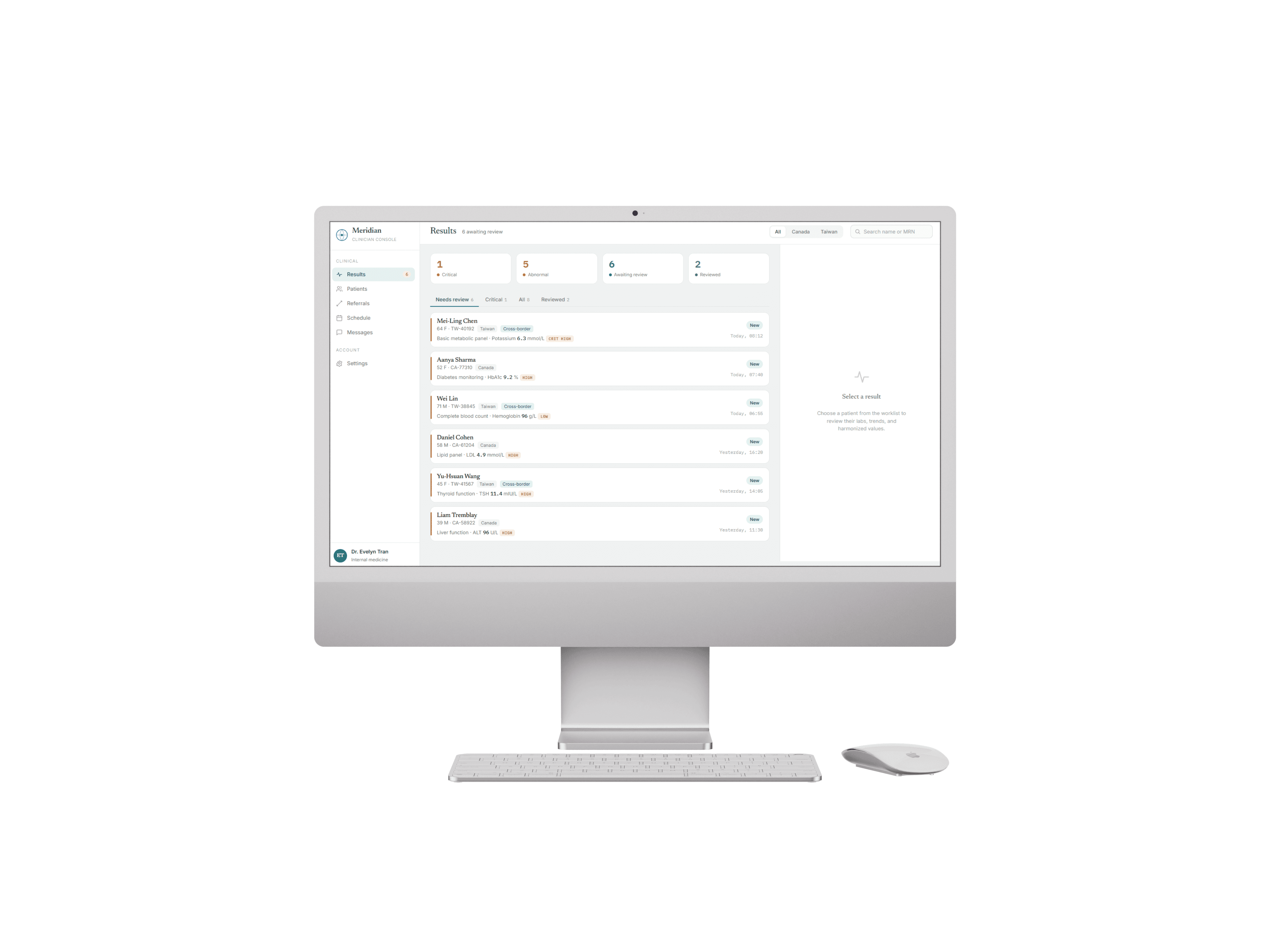
Triage. The worklist is a queue sorted by urgency. The critical potassium sits at the top demanding attention, abnormals below it, reviewed cases dimmed out of the way. Region pills filter to one country, tabs cut to what needs review, search finds a patient by name or record number. The job of this screen is to answer one question fast: what needs me right now.
Review. Click a patient and the full panel opens. Every analyte with its reference range, a small position bar showing exactly where the value sits relative to normal, and a trend chart with the healthy range shaded so you watch the value climbing out of it over the last few collections. The trend is what turns a single scary number into a story, is this new, or has it been building.
Act. Mark reviewed clears the case from the queue and updates the counts. The worklist is a thing you work down to zero, and the interface respects that.
What I cut, and why
I left out messaging threads, full chart history, billing, and scheduling. A clinician's day has all of that, but the moment I was designing for is narrower: results came in, which ones need me, what do I do. Everything that did not serve that moment got cut so the harmonization and the triage could be the whole story.
A concept earns its sharpness by refusing to be a whole platform.
What I'd test next
It is a concept, so no adoption numbers, just the questions I would actually want answered:
Does harmonizing by default feel safe, or do clinicians want to see the original units first and convert themselves
Is the position bar the fastest way to read in or out of range, or is the number and flag enough
Does the trend change the decision, or do people act on the latest value alone
I would sit with a few doctors who work across systems and watch exactly where they pause or double check. That pause is the design brief.
What I took from it
The strongest design decision here was not visual. It was noticing that the real problem hid in the units, the thing two countries quietly disagree on, and building the product around fixing it rather than around the charts.
Calm was a choice, not a default. On a screen where someone makes real decisions, restraint is the feature.